Tag Archive for 'Frontex'

“Please don’t paint…”

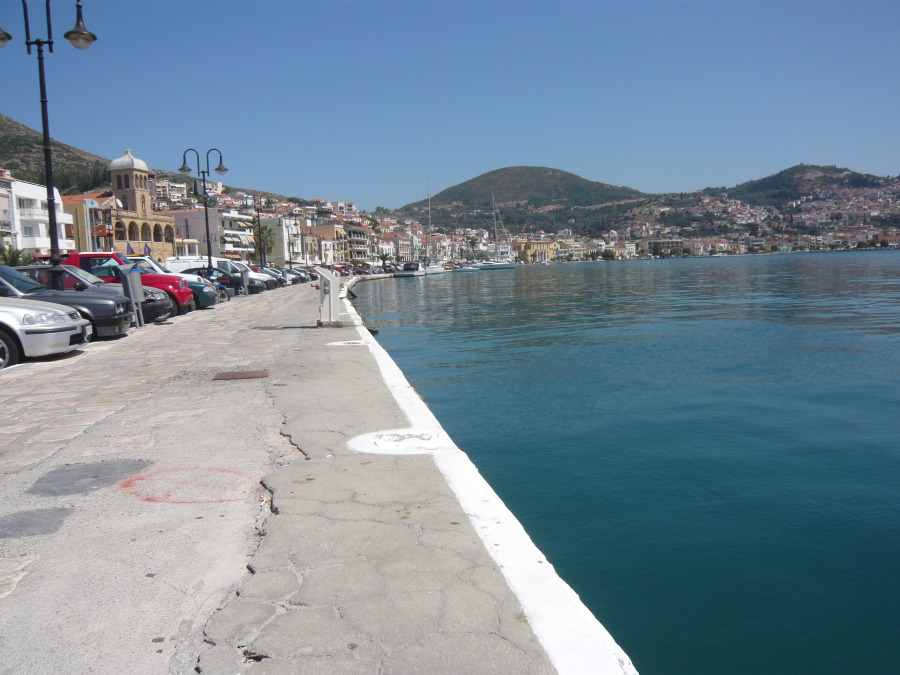
Today, Saturday, was the designated Frontex action day in Samos. We scored our first victory in the morning when all coast guard and Frontex ships withdrew from the port, disappearing somewhere. Up to now, they have not returned. The image below shows where they usually park their ships during the day… it is empty. We demilitarised, de-frontexisised Vathy, at least for a day.

Continue reading ‘“Please don’t paint…”’

First Words from Samos

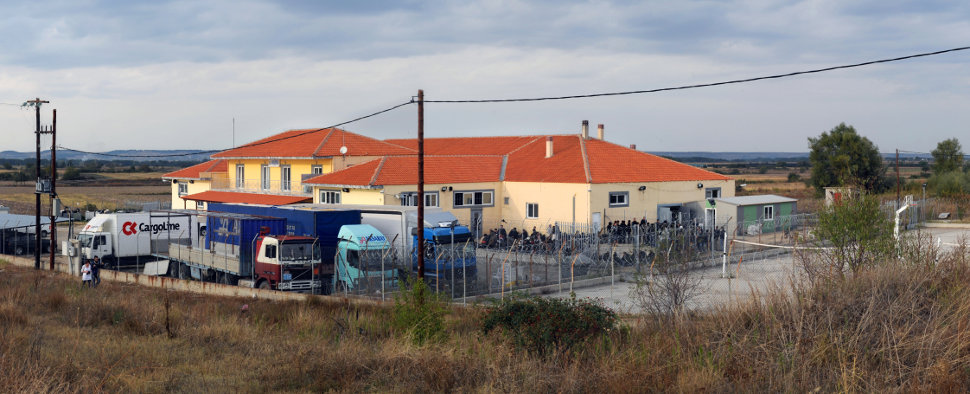
In the last few days we gradually arrived in Samos and found a totally unexpected situation. The huge detention centre above Vathy is empty, all detainees have been transferred off the island, presumably to Athens, where they are either held in another detention facility or are released with the infamous White Paper.

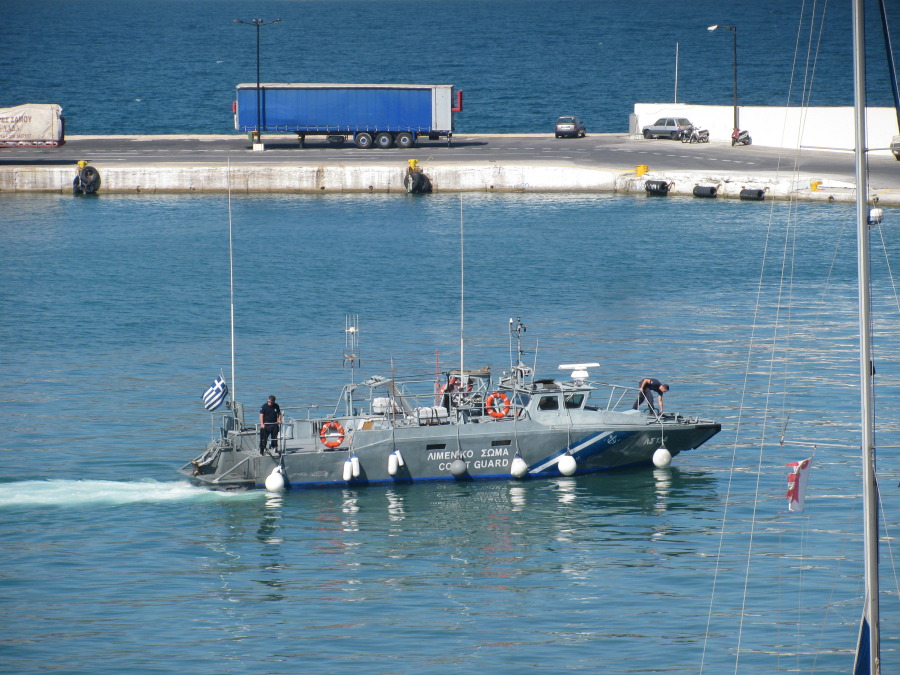
Currently, there is an Italian Guardia Frontera ship in the harbour representing FRONTEX. The Dutch coast guard is present with a speedboat. From our observations, the latter basically go around and drink coffee at the various beaches. The Greek coast guard has two boats in Vathy, one of them is broken, though. The Italian Frontex ship leaves every night at 10 p.m. and returns in the early morning – but these days they are not very “successful”: According to what they say, they have not caught anybody during the last weeks. Inhabitants told us that still some people arrive on the island but without being caught. But compared to last year, arrivals have dropped dramatically. According to a chatty coast guard officer most refugees now choose the route via the Evros region in the north of Greece. The few people caught on the island are imprisoned in one of three police stations on the island and usually not taken to the detention centre, but sent to Athens straight.

Continue reading ‘First Words from Samos’

Frontex office delayed?

Well, well, nothing is ever moving as fast as said. A new article in The Economist brings the news that apparently, the opening of Frontex’ Branch Office in the port of Piraeus will be delayed until October, after it was supposed to first open in spring, then in August.

There are two more aspects in the article that are worth noting, summarised in this paragraph:

So Brussels is sending in the cavalry. Frontex, a Warsaw-based agency created in 2004 to manage the EU’s external borders, will open a pilot office in the Greek port of Piraeus in October. Earlier this month its executive director, Ilkka Laitinen, went to Athens to finalise the plan with Greece’s home-affairs minister, Michalis Chrisochoidis. There was much talk of “milestones” and “adding value”. But there were hints of frustration behind the smiles. Mr Chrisochoidis welcomed the symbolism of the move but says in practical terms it will be “a drop in the ocean”. As for Frontex, squeezed by budgetary and personnel constraints, Mr Laitinen politely describes its job as “a challenge”.

Well, the Economist might have it the wrong way, since it also credits to job of managing the EU’s external borders to Frontex, which is not really true. However, the image of the cavalry is interesting, as it might still be sufficiently describing the role of Frontex in Greece: They don’t come to support, they don’t come to coordinate, they come to get the job done, and that by any means necessary. We have already described what that means: Maximising border “security” by all means, minimising the respect for human rights and international law. Or is this again a misconception, citing the drop in the ocean? We will be in Greece to find out.

Patras & Frontex

Just to keep you updated on the activities of Frontex in the Aegean, we dug out this recent article from a local newspaper, reporting about Frontex in Patras. Is the advertisement next to it not great? Yes, the Mediterranean used to be an area of travel, exchange and commerce, why did we turn it into a mass grave?

Our friendly translator says:

4 coastguards of Patras Central Post Authority are following a special training program and will be the Frontex “branch” in Patras. They will report on the current situation for the implementation of the appropriate interventions.
[…]
Training consists of 3 levels and we completed two of them. Seminars are taking place in several countries. Me, for example, I have been trained in Spain and Italy. We will try to help the Frontex specialists group which will visit us, by providing crucial information, Evangelos Agelis, vice-president of Patras coastguards and one of the 4 coastguards in special training program, said.
[…]
In Patras port 2 german and 1 italian policemen are taking part in passport controls in order to reduce illegall migration.

This year, the Schengen Agreements turn 25 years, supposedly providing for passport-check-free travel in Schengenland. So how are those three border guards mentioned in the last paragraph controlling?

Samos

Samos is one of the Greek island off the Turkish coast. At the closest point, you have the feeling you can easily touch the other side if you stretch your arm a little. Not surprisingly, many refugees and migrants attempt to cross the border to the European Union here with small boats.

In 2007, a new detention centre was opened on the hills above the island’s capitol Vathy. Before, migrants were detained right in the city centre, behind the main church and the city hall, in the first floor of an old, run-down building. All those that passed this jail said that the conditions were unimaginable and made many people sick. With funding from the European Union, the new detention centre is nothing like that. It consists of 14 buildings made from metal, most of them are used for the detainees while some are administrative buildings. The whole camp is surrounded by a double barb-wired fence, CCTV cameras as well as loudspeakers are everywhere: bidirectional communication to the advantage of the guards. The camp even has a children’s playground as well as a basketball court. Too bad that there are no basketballs available, so the court is mainly used in summer, when the capacity of the camp does not suffice and newly detained migrants have to sleep there, on the bare ground (like in 2009).

Continue reading ‘Samos’

Screening, Detention, Centres

In October 2009, the Initial Reception Centre in Pagani on the island of Lesvos was officially closed, after a wave of revolts of the detained migrants and a worldwide scandalisation of the conditions inside the jail. Despite announcements of the government to build a new detention centre in Lesvos, Pagani is still the only detention infrastructure on the island. The former goods warehouse is used for the interim detention of newly arrived refugees and migrants. Unlike before, when hundreds of migrants where kept for months in closed cells, fewer people stay there for some days only until they are transferred to the reception centre on the closely located island Chios. However, since the closure of Pagani it has become clear that the old system of detention under horrible conditions cannot be continued and will be replaced by a more human rights compatible system of detention in line with the existing models in the European detention landscape.

Indicative of this change in policy, which also stems from the change of the Greek government in October 2009, is the statement of the then newly instated Deputy Citizens’ Protection Minister Spyros Vougias during his visit of Pagani in October 2009, shortly before the actual closing of the detention centre by his ministery. He promised “to upgrade infrastructure and curb bureaucracy so that the migrants are detained for shorter periods of time and with more dignity”.

Continue reading ‘Screening, Detention, Centres’

Frontex in the Aegean

In 2009, 150.000 irregular migrants were intercepted in Greece, which amounts for 75% of all interceptions in the EU. Even though in 2010, this number is likely to drop again, it is clear that the closure of other routes to Europe (West Africa to Spain, Libya to Italy/Malta) has made Greece the presently last remaining gateway to the EU, turning it into a embattled ground where the EU is intervening decisively.

There are three tested responses to irregular migration, and the operations of Frontex in Greece and the Aegean have elements of all of them. The first would be to integrate Turkey into the border regime (similar to the case of Libya). On an institutional level, Frontex is trying to connect with the Turkish coast guard and to involve them in joint maneuvers and also seeks a working agreement with the Turkish border authority. But also Greece and the EU are trying to improve their cooperation with Turkey on migration matters: While Greece and Turkey have a readmission agreement (which Greece would like to extend, since practically, its functioning is questionable), the EU has been negotiating such an agreement for many years with Turkey, albeit without success so far. Functional readmission agreements would force Turkey to readmit not only nationals, but all irregular migrants who can be proved to have entered Greece and the EU via Turkey. This would shift the responsibility for securing borders and inhibiting the movements of migration to Turkey.

Continue reading ‘Frontex in the Aegean’

Frontex frames innocent youth in Samos

M., a 17-year-old Palestinian youth was accused of “trafficking” in Samos. Four months ago, M. was arrested by the police, when he arrived in a boat together with another 55 people. The police claimed to have him identified as the driver of the boat. The accusation was based on a photo made from a helicopter that was stationed in Samos as part of the Frontex operation Poseidon. Despite being a minor, he was imprisoned, awaiting his trial. The Samos solidarity group heard about his case and organised a lawyer. He was in front of a court, but finally acquitted and set free.

Welcome To Europe made an interview with M. in June 2010, after the trial was over. His friend A. acted as a translator.

w2eu: Please tell us what happened.

M.: The police works in the sea, looking for people coming and they look with goggles. I was afraid because i was the youngest person in the boat, so I stayed near the engine. But I didn’t drive, because the big one drives, because he knows Samos, he knows the sea, he knows everything. In my country there is no sea. So I am absolutely no driver. The helicopter is coming with a big light and after that the police take me. I asked them why me? They say because the police saw me in the boat near the engine. But the photo is not very good because you can’t see in the sea if you drive or not, because the driver is clever, he stays behind and he puts his hand in the engine and he drives from far away.

Continue reading ‘Frontex frames innocent youth in Samos’

Samos: preparations for the deportation of 50 refugees

From Samos, the Movement for the Human Rights Solidarity to the Refugees sends a press release, denouncing the pending deportation of 50 refugees from the island. In a presse release, they write:

For one more time on thursday 1/7/2010 50 refugees where transported from the detention center of samos to be deported. They where transferred to the center of Aspropyrgos (detention centre near Athens) without having been informed that they will be transferred or the reasons without lawyers and without translators. For one more time the police, the coast guard and Frontex coordinate their actions and transferred illegaly also a minor of 15 years with health problems.

Who gives the permission to frontex to be inside the detention centers and to collect information from the refugees and decides about their nationalities and their deportation?

In the same way like the Greek Government accepts that the European Union and the International money fonds take decisions against the working greeks in the same way the greek Goverment has let the decisions about the future of the refugees to Frontex forgetting everything about constitution and conventions on human rights.

We are denouncing this practices and unite our voices with all humans beings who act against this violations of human rights.

We are in solidarity with this people who where forced to abandon their countries and flee because of wars, poverty and desertation that causes the imperialist atrocity.

Those who produce refugees, face the refugees as criminals, without rights, without voice, without future.
Solidarity is our weapon.

Movement for the Human Rights Solidarity to the Refugees – Samos (4th of June)

Announcement by the Samos Group

On Monday, 12 of April the refugees detained in Samos Detention Center came on a hunger strike in which participate the great majority (126 hunger strikers in 150 detainees). The reason was the two massive transportations happened in 21 of March and 9 of April (60 refugees transferred in the northern greek borders each time). They react because they are afraid that they will be the next that will be transferred in the northern greek borders in order to be deported, despite the fact that the massive deportations are illegal and consist clear violation of human rights.

The most of them are Palestinians and they gave us a text in which they announce that it’s better for them to commit suicide than to be deported. They insist on their right to be released with formal papers and tickets and not to go through any kind of violence. According to their denounce, they have been violated to sign papers in an unknown language without any translator. Also, no one has informed them about their rights. Furthermore, the police change their nationalities in order to deport them, and because they cannot proof their nationalities and their problems, so there is no any concrete asylum procedure because in reality.

They also denounce us that on Tuesday, 13 of April in the morning there happened a violent incident. The police-guards beat a refugee and then they send him in the Samos’ hospital.

The Group for the Human Rights – Solidarity to Refugees tried from the beginning to go near the refugees, to discuss their problems and to hear their demands. On Tuesday, 13 of April ten members of our group went in the detention center to have a contact with the refugees. Suddenly the police commander denied our entrance because “there is no need any more” according to their words. We stayed outside the camp trying to communicate with the refugees from outside the fence. The police terrorized us, trying to keep us away. The police accused us that the revolt is our blame and they asked our identities.

We are sure that both the increased deportations and the denial of the access to the group is the result of the tough migration policy and of the permanent and improved role of FRONTEX on the island. We know that FRONTEX works 24 hours per day in the airport.

Solidarity to the refugees’ struggle. We demand the acceptance of their demands. Deport FRONTEX!

14 April 2010
Group for the Human Rights-Solidarity to Refugees
Samos

About w2eu

This is the blog of the antiracist network Welcome to Europe. It was formerly known as lesvos09.antira.info.


The name Welcome to Europe expresses the discontent and anger we feel when looking at the fatal realities of the European external border: the long documented deaths and suffering have continued for years, and no end is in sight. We stand for a grassroots movement that embraces migration and wants to create a Europe of hospitality.


We maintain our focus on the European external border in Greece, but will not limit ourselves to that geographical area. The right of freely roaming the globe has to be fought for everywhere. Join us!


get in touch, follow us

Categories

Voices from the Inside of Pagani (2009)

Watch the video

Our Tweets